Auckland New Zealand
| Song Title | Writer | Performer |
|---|---|---|
| Script 1 | ||
| Brian walks on, opens his book . . . | ||
| Isolated by the vastness of the world's greatest ocean, Aoteoroa NZ, the last habitable land mass of any size, remained untouched by man's foot-print for millions of years . . . | ||
| Karanga | Niya | |
| Script 2 | ||
| Despite the incredible distance and the challenges of navigation, a well provisioned catamaran crewed by Polynesians, made it's landfall on the northeastern coast of the North Island. The tribes who were to settle here, fought over this land for hundreds of years . . . | ||
| Destruction Gully | Roger White | Roger White |
| (situated off the road to Whatipu, up from Little Huia, it gets it's name from inter iwi clashes between Ngati-whatua & Kawerua.) | ||
| Script 3 | ||
| Then came the European. Dutchman Abel Tasman in 1642. Contact at Golden Bay with the Ngati Tuu-mata-Caw-ki-ree people ended in bloodshed. Tasman sailed away, never to return. Over a century passed before the next Europeans ventured here. In 1769, British explorer, James Cook and the Frenchman, deSurville, simultaneously re-discovered New Zealand - each without knowledge of the other. It was Cook who circumnavigated the land and outlined - as best he could - it's shape on maps of the Pacific. The Pakeha was here to stay. In 1792 the first sealing gang came to Dusky Sound. The furious activity of the many gangs that worked the Otago coast up until the 1820's virtually exterminated the seals. . . | ||
| Davy Lowriston | Trad / Anon | Westumbria |
| (Ship's mate, David lowrieston & other sealers were left on an island in Fiordland in 1810. They were there for nearly 4 years before rescue by the Governor Bligh) | ||
| Script 4 | ||
| Early European settlements were not always attractive places, with their rum trading and the sometimes mercenary inhabitants originating from the convict settlements across the Tasman. The perception of growing lawlessness led missionaries to press a reluctant Britain, under the rule of Queen Victoria, to take NZ on as a colony. And on the 6th of February 1840 in the Bay of Islands, the treaty of Waitangi came into being. The missionaries were led by the Rev. Samual Marsden, who preached the first Christian sermon in NZ on Christmas Day in 1814. | ||
| Te Harinui | Willow Macky | Rosemary Thomas |
| (The missionaries were led by Rev. Samuel Marsden who preached the 1st Christian sermon in NZ on Christmas Day in 1814) | ||
| Script 5 | ||
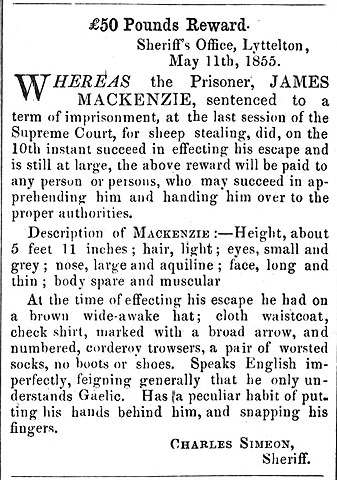 | ||
| MacKenzie's Ghost | Kath Tait | Suzanne Timms |
| (In 1855, MacKenzie, with the help of his dog, stole a mob of sheep & drove them into the district now known as MacKenzie Country) | ||
| Script 6 | ||
| New Zealand made beer had it's first tasting in 1773, brewed by order of James Cook, who believed that beer would help fight scurvy, a disease common to sailors of the time. It was brewed using wort with molasses and leaves and bark of the rimu.But it wasn't until 1835 that the first commercial brewery was established by Joel Samuel Polack, in the Bay of Islands. | ||
| "Cheers mate!" "Aye, cheers!" Bob Large & Paul Howarth | ||
| Shanties By The Way | Traditional | Rudy Sunde |
| ("Shanty" was the name given to the bush pubs that were found on the southern gold fields) | ||
| Script 7 | ||
| "Extra, extra! Read all about it! Gold found in Otago!" Rosemary Thomas | ||
| In May 1861, Gabriel Read discovered a large deposit of alluvial gold while prospecting along the Tuapeka River in Otago. Gold-fever quickly took hold and within a week, a city of tents appeared, stretching for miles along the river. | ||
| Bright Fine Gold | Trad. - music by Ward/Park/Colquhoun | Jean Reid, Andrea Reid, Jo Hill |
| Script 8 | ||
| Roger White - to walk on with a shaving brush, and holding a dress) | ||
| The Close Shave | Bob Bickerton | Ian Bartlett |
| Script 9 | ||
| In 1863 the HMS Orpheus was ordered, under the command of Commodore William Burnett, to assist Governor Gray in his dealings with Maori. HMS Orpheus was also to deliver a quantity of gold to allow the military to employ more soldiers. But Orpheus became stricken on the Manukau sandbar and the tragic loss of 180 of her men remains NZ's worst shipping disaster to this day. Legend has it that the gold was rowed ashore and buried in the sand dunes. There are also several stories of undisclosed survivors - pressed men who didn't wish to remain in the Queen's service. | ||
| Orhpheus | Rosemary Thomas | Rosemary Thomas & Ron Baker |
| Script 10 | ||
| Before the completion of the main trunk railway line in 1908, public transport was by coach. Melbourne company Cobb & Co. did their first run in 1871. However, prior to this, private coach owners throughout NZ used the Cobb & Co trade name to take advantage of their public image of reliability and punctuality. | ||
| The Stable Lad | Lyrics - Peter Cape, Tune - Phil Garland | Paul Howarth |
| INTERMISSION | ||
| Script 11 | ||
| Kauri gum - the fossilised resin of kauri trees that had lived and died thousands of years ago. Maoris used it as fuel and as torches. Soot from burnt gum was used in tattooing. And It was even used as chewing gum. Early Europeans did not at first recognize the gum's economic worth, but by the late 1800's exports outshone even gold. Among the gum diggers were hundreds of young Dalmatian immigrants, who had left their homeland in their teens to avoid being conscripted into the armed forces at the age of 18. | ||
| The Figs & the Vines | Rudy Sunde | Rudy Sunde |
| Script 12 | ||
| "Did you hear the singin' from the the Dallie camp last night?", Roger White "Aye, hair-raisin', w'nt it!" Ian Bartlett | ||
| Black Swans | Anon/music by Neil Colquhoun | Bob Large |
| Script 13 | ||
| NZ was hailed in the late 1800's as the social laboratory of the world. By 1893 it was the most democratic state in the world - or that had ever existed. In this same year New Zealand women were given the vote - a world first. Then came another world first - the great war - "the war to end all wars" they said. Unfortunately this was not to be. And in the years between came a world wide depression. . . . | ||
| "Little Henry's shoes have got holes in them - through & through!" Angela Fox "Put a piece of cardboard in them - that'll keep them going a bit longer" Sylvia LaTrobe | ||
| My Man's Gone | Traditional (collected by Colquhoun) | Jean Reid, Andrea Reid, Jo Hill |
| Script 14 | ||
| The search for timber has attracted Europeans to NZ from the late 1700s. There are many places where the signs of the loggers are still visible today - ironworks from bush tramways used to carry the logs; remains of the holding & driving dams. Some of these structures involved 50 bushman in months of work, before the dam was full of winter rain. What a sight it would have been to see the dams tripped, and the logs sent crashing down the gorge to the holding dams below. | ||
| The Dying Bushman | Traditional (collected by Phil Garland) | Paul Howarth |
| Script 15 | ||
| The much respected surf lifesaving clubs are familiar sights on New Zealand's beaches - especially on the west coast where surf is heavy and treacherous year round. Piha's surf club was founded in January 1934 and typically performs over 500 rescues annually. The Karekare Surf Club was founded the following year. Although these beaches have claimed the lives of many, few have died between the flags. | ||
| Karekare | Jocelyn Aydon | Jocelyn Aydon |
| Script 16 | ||
| Surrounded by so much water, and with so many living so close to the sea, it was inevitable that sailing and fishing would be a popular pass-time in New Zealand. | ||
| The Man From Smokehouse Bay | Bob Large | Bob Large |
| Script 17 | ||
| The first sod dug for the North Island Main Trunk Railway was on the 15th of April 1885 and on the 7th of August 1908 the first train traveled from Wellington to Auckland. For decades this was New Zealand's most important transport route. The railway linking Auckland to Henderson was completed much earlier in 1881. Rail lost it's popularity for many years as cars became cheaper and more convenient. . . . | ||
| Silver Rails | Roger White | Roger White |
| Script 18 | ||
| The "Folk revival" and "hippie culture" of the 1960's in the northern hemisphere, was somewhat delayed in New Zealand and was still going strong well into the '70s. Back then, weekend shopping was a novelty - and Cook Street Market was the hippest place in town . . . . | ||
| Jean & Andrea Reid - Hippy skit. | ||
| Market Song | Tina Wolfe (extra lyrics by Sieffe LaTrobe) | Ronrossie |
| Script 19 | ||
| Buskers became a familiar sight around the city shopping centres - especially on Friday nights . . . | ||
| Ian to wander over to Jocelyn, pull some coins out of his pocket & them into a hat. | ||
| Cold City | Jocelyn Aydon | Jocelyn Aydon |
| Script 20 | ||
| As well as the buskers, there were others who also touted their wares on the evening streets . . . . | ||
| Ponsonby Blues | Graham McGregor | Graham McGregor |
| Script 21 | ||
| Peter Blake. Sailor, adventurer, Kiwi icon. After winning the Whitbread, Peter Blake took on the America's cup. In the famous "Little Black Boat", he took the trophy off the U.S. in 1998 - this being only the 2nd time any country other than America had won it. Not only did his team win, but they also successfully defended it - being the only country other than America to have done so. | ||
| Little Black Boat | Pete Stretch | Pete Stretch |
| Script 22 | ||
| Though many think that folk music died in the 70's, there are many NZ songwriters who still choose "folk" as their genre . . . | ||
| The Moon, the Darkness & You | Kath Tait | Angela Fox |
| A couple walk on arm in arm, (Ian & Jean?) hug centre stage, wave goodbye "Don't forget to write!" (Ian) "I'll miss you!" (Jean) "Bye!" (both) leave in opposite directions | ||
| Miss You | Angela Fox | Angela Fox |
| Script 23 | ||
| Not only are there folk songwriters, there are many popular Folk Festivals in New Zealand where the folk tradition is still alive and kicking. One festival became too popular and due to lack of space and facilities sadly had to close it's gates . . . | ||
| Farewell to Tahora | Sieffe LaTrobe | Westumbria |
| Script 24 | ||
| Which brings us to the present day, and our young people are writing the folk songs of the next age . . . | ||
| Dance of the Shadow Puppets | Andrea Reid | Andrea Reid |
| Script 25 | ||
| And that brings to an end tonight’s Folk Song Storybook. | ||
| Close book. | ||
The evening was created by the work of a large number of people, most of whom are listed above but particular mention needs to go to the following for their work in putting the evening together:-
And last but by no means least Titirangi Festival of Music for programming this event as part of the Festival.
Back to March 2009 calendar.
Last Update:2009-04-08


The Club was conceived in 1965 when the Clancy Brothers didn't come and someone had the astounding idea of having a sing-a-round thus transforming an audience into a folk group. Formally established in 1966 we're still going strong.